

Paint coverage per gallon is a planning estimate, not a promise that every container will cover the same area on every wall. The product label gives the best starting point, while surface texture, porosity, color change, application method, and coats affect how much paint a project uses.
A careful estimate begins with the paintable surface area rather than the home’s floor area. On Hawaii Island, sun-exposed exteriors and interior rooms with different textures may need different products and amounts.
This guide shows how to estimate paint quantity, where the usual coverage range comes from, and when to leave room for surface variation. TTT Industries provides painting services across Hawaii Island.
Table of Contents
Quick Facts and Key Takeaways
| Topic | What to Know |
|---|---|
| Coverage unit | Square feet per gallon for a named product |
| Formula | Paintable area ÷ stated coverage × number of coats |
| Separate materials | Primer, trim paint, and finish coats may differ |
| Common adjustment | Texture, porosity, color change, and application |
| Control | Use product data and record the exact color and sheen |
Calculate the area before dividing by coverage
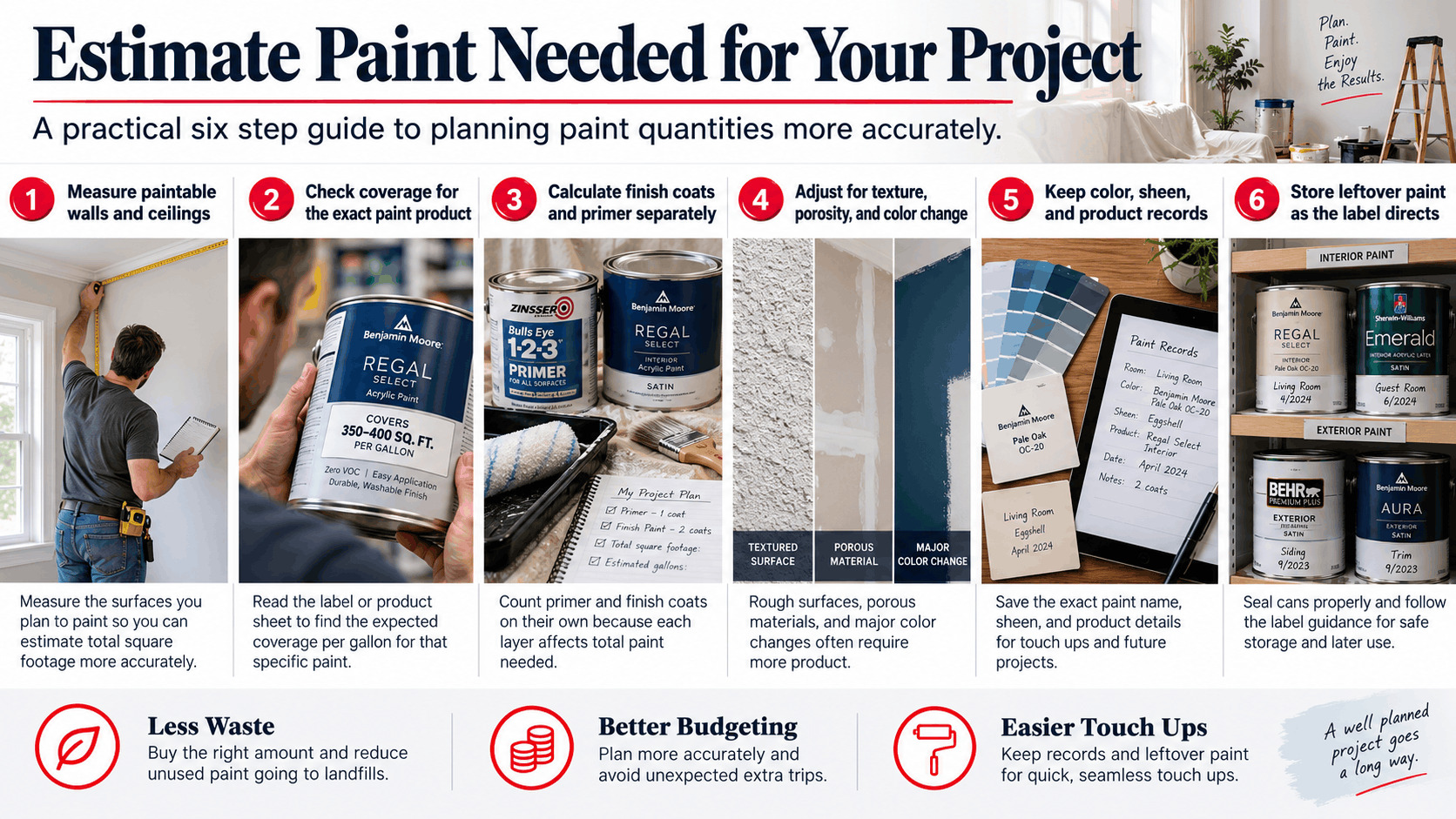
Measure each wall’s width and height, then total the areas. Subtract large openings only if the estimator’s method accounts for them; small doors and windows may be simpler to leave in the total as a buffer. Ceilings, trim, doors, and cabinets should be calculated separately because they may use different products.
Divide the paintable area by the product’s stated coverage to get a one-coat estimate. If two finish coats are specified, multiply the area requirement accordingly. Primer may need its own quantity and coverage rate.
Adjust the estimate for the surface
Smooth, sealed drywall may use less paint than rough, porous masonry or textured stucco. A major color change can require more coats or a tinted primer. Old surfaces that absorb paint unevenly can also use more material than a clean, uniform wall.
Sherwin Williams says a gallon typically covers about 350 to 400 square feet, but its own guidance notes that wall texture and desired coverage can change the amount needed. Exterior products can have a broader stated range. Check the exact product data instead of reusing a number from another paint.
Avoid both shortages and waste
Buying one extra container may be useful when color matching later would be difficult, but extra paint should not replace a measured estimate. Keep the product label and color code, and store leftover paint according to its instructions.
For contractor work, ask whether the bid includes materials and how unused paint is handled. A crew may order a small buffer for touch-ups, but the owner should know who owns the remaining product and whether it will be left on site.
Verified Data Points Worth Knowing
- Sherwin Williams’ paint calculator FAQ gives a typical range of about 350 to 400 square feet per gallon.
- Sherwin Williams notes that texture and desired coverage affect actual paint quantity.
- For exterior projects, Sherwin Williams gives a broader approximate range of 250 to 400 square feet per gallon.
These references provide general context. They do not establish a Hawaii Island quote, certify a particular contractor, or replace product labels, manufacturer instructions, or rules that apply to the specific property.
What to Check Before You Begin
Use the site condition, written scope, access plan, and closeout details to compare options. Ask the provider to explain any assumption that affects cost, safety, material choice, or schedule.
- Measure walls, ceilings, trim, and doors as separate surfaces.
- Use the coverage printed for the exact product.
- Multiply for the specified number of coats and include primer separately.
- Increase the estimate for porous texture, color change, or uneven absorption.
- Keep product name, sheen, color code, and leftover paint record.
TTT Industries and Other Ways to Handle the Project
The comparison below is a planning aid, not a ranking. Match the approach to the project size, surface condition, access, and qualifications the work requires.
| Approach | Potential strength | Limit to consider |
|---|---|---|
| Smooth drywall | Often nearer to product’s typical range | Still allow for coats, repairs, and color change |
| Rough or porous surface | May consume more coating | Check manufacturer guidance and test area |
| Major color shift | May need extra coat or primer | Ask product supplier for a system recommendation |
No approach suits every property. Compare the actual work, access, and risk before choosing between a specialist, a broader maintenance provider, or an owner-managed project.
A Practical Hawaii Island Project Plan
- Measure each surface and record dimensions.
- Choose the exact product and read its coverage data.
- Calculate coat and primer quantities separately.
- Add a reasonable allowance for surface conditions.
- Save the product and color record for future touch-ups.
A written plan makes the work easier to review because the owner and provider can see the same surfaces, responsibilities, and decision points. Adjust the steps to the property and confirm product or safety requirements with the appropriate source.
When TTT Industries Is a Good Fit and When It Is Not
TTT Industries can help assess painting needs on Hawaii Island when a property owner wants a professional scope and material plan. A gallon estimate alone cannot determine project labor, repairs, access, or final cost. Review current painting services and request a site assessment if the quantity is uncertain.
Related Reading Within This Topic Cluster
- Exterior House Painting Rates in Hawaii Guide for related planning and service guidance.
- Can You Use Exterior Paint on the Inside for related planning and service guidance.
- Cost to Paint a House Exterior in 2026 for related planning and service guidance.
These topics answer different questions within the same service area. Link the live pages together after publication so readers can move from initial research to a more specific planning decision.
Paint coverage per gallon: calculate the amount for your project
Product labels provide a starting point for paint coverage per gallon, but the listed area is an estimate under stated conditions. Measure the surface that will be coated and check whether the product’s coverage guidance applies to your material, application method, and desired finish.
Surface texture and porosity can change how much paint is needed. Bare, patched, rough, or previously painted areas may absorb or distribute paint differently. Color changes can also affect the number of coats required. Use the manufacturer’s directions and include separate measurements for walls, ceilings, trim, and other surfaces.
Do not rely only on room floor area when estimating wall paint. Measure wall height and length, account for openings when appropriate, and consider whether closets or detailed trim are included. A paint calculator can help organize measurements, but it cannot inspect the actual surface or guarantee exact consumption.
Before purchasing, confirm the product, sheen, color, and planned coat count with the painter. Keep the label details so additional paint can be matched if needed. TTT Industries can review the surfaces and preparation plan for a Hawaiʻi Island painting project and help clarify what the written scope includes.
For future touch ups, record the paint name, finish, color, and batch information when available. A paint coverage per gallon estimate is only a planning guide, so keep the remaining product details with your project notes and follow the manufacturer’s storage instructions.
If more than one coat is planned, include each coat when estimating total material. Ask the painter to confirm whether the product coverage figure is realistic for the surface and application method, then keep the label information for future reference.
To answer “paint coverage per gallon,” begin with measured paintable area, surface material, stories, trim, access, and the preparation the property needs. A useful discussion of “paint coverage per gallon” separates labor, paint, primer, repairs, equipment, masking, and cleanup instead of relying on a broad average. For a Hawaiʻi Island estimate, “paint coverage per gallon” should be evaluated with local access, weather, travel, material availability, and the condition found at inspection.
Final Thoughts
The most useful decision starts with the property and the work it needs. Review the actual condition, compare a clear scope, and make sure the plan respects access, safety, materials, and local site conditions.
For a Hawaii Island assessment, contact us and describe the surfaces or service you want reviewed. The company can confirm whether the request fits its current scope.