
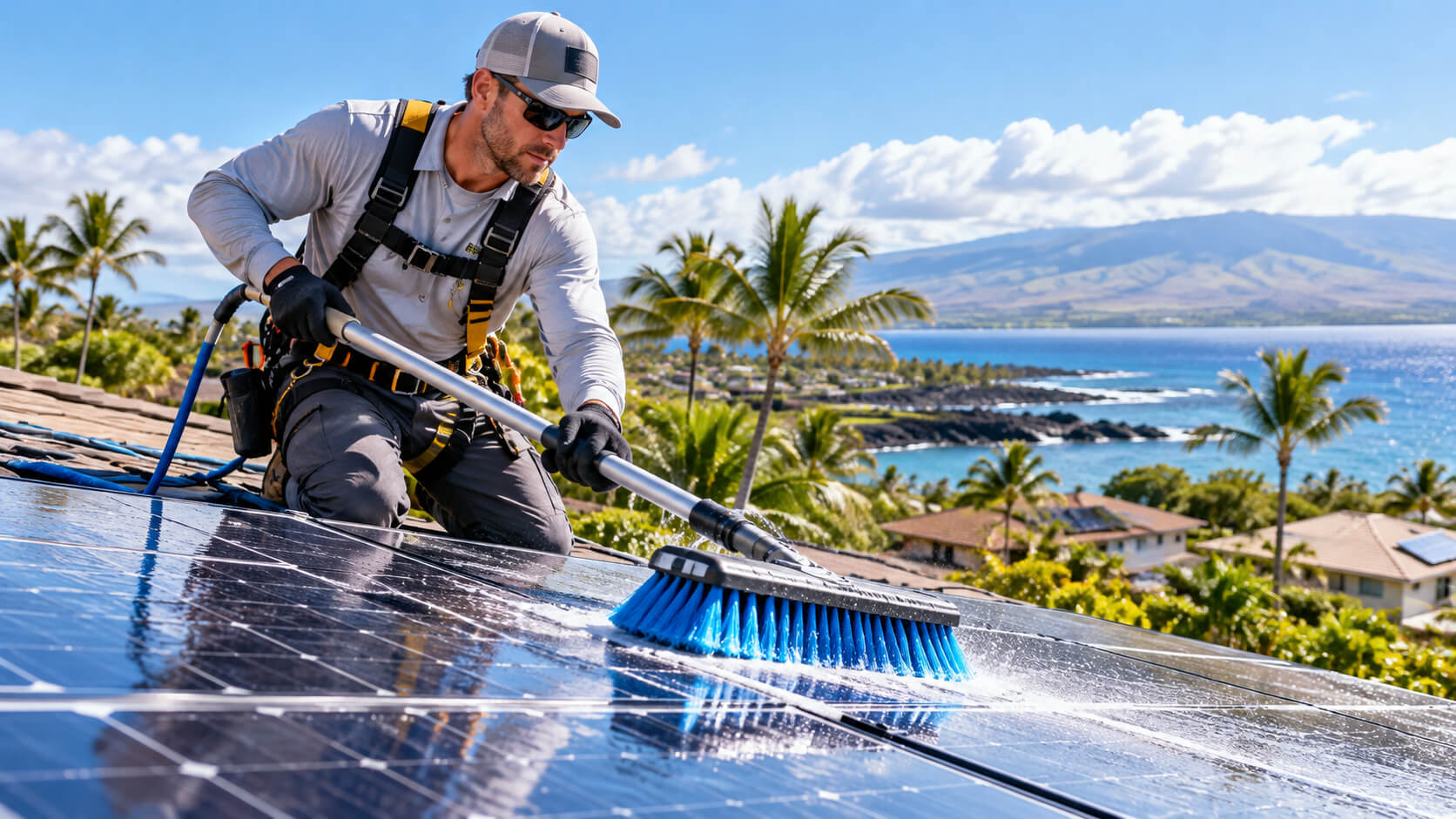
A search for solar panel cleaners near me is most useful when it helps an owner find a provider who understands the system, roof, and local access conditions. Nearby service alone does not prove that the cleaning method follows the module maker’s instructions.
On Hawaii Island, properties can have steep roofs, tile surfaces, limited pathways, or arrays near the coast and vegetation. Send the system location and clear ground-level photos when asking about service; confirm whether a site review is needed before the crew quotes.
This guide focuses on evaluating a local solar cleaning provider and separating cleaning from electrical work. TTT Industries provides solar panel cleaning on Hawaii Island.
Table of Contents
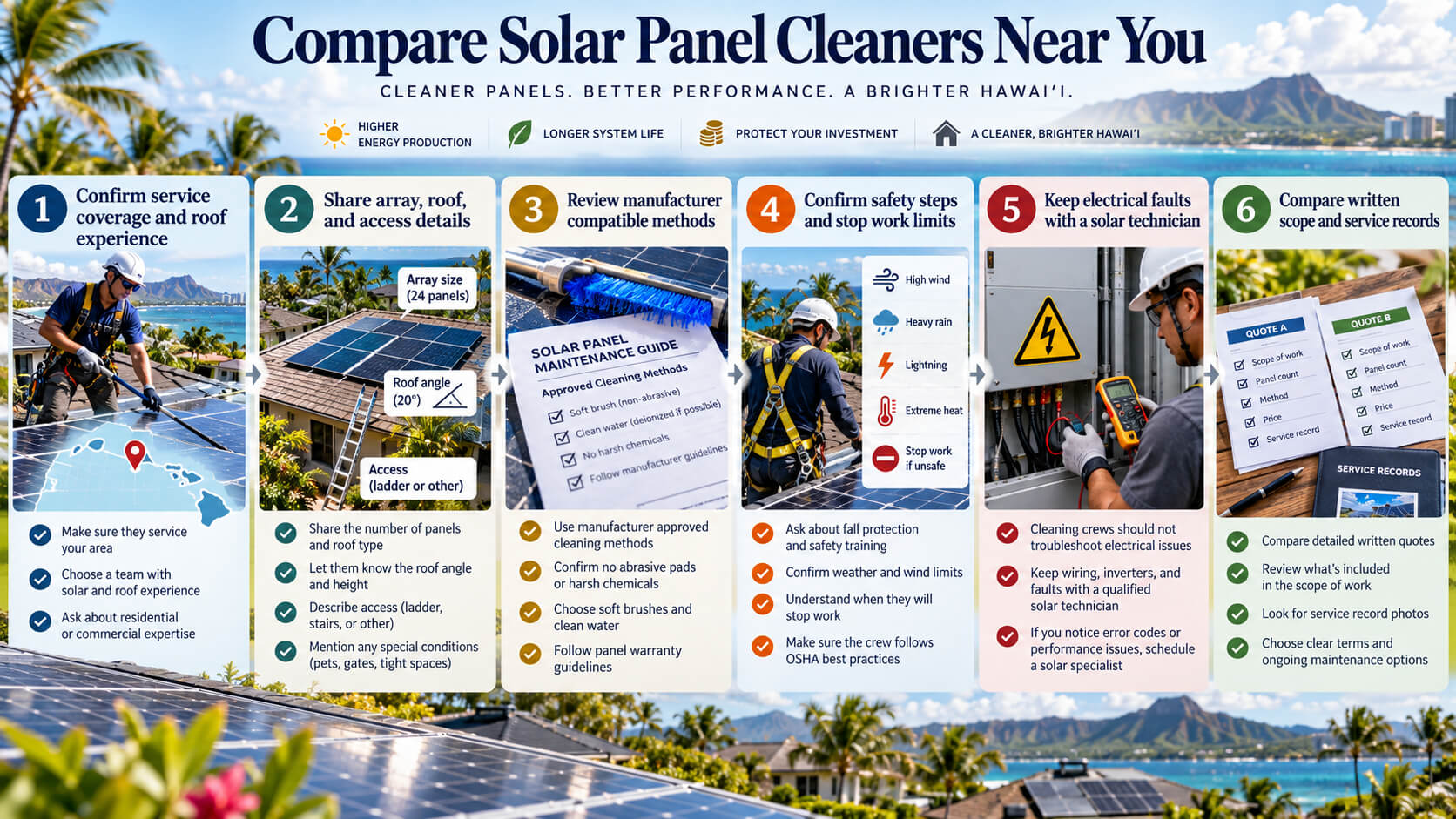
Quick Facts and Key Takeaways
| Topic | What to Know |
|---|---|
| Local fit | Service area, roof type, array size, and access |
| Cleaning practice | Tools and water compatible with manufacturer instructions |
| Safety | Roof route, fall controls, and stop-work conditions |
| Records | Photos and a clear list of areas reached |
| Referral line | Electrical or inverter issues go to a solar technician |
Check local service and roof experience
Ask which communities the provider serves and whether it has worked with the roof type and access conditions at your property. Clarify whether the estimate includes travel, a site visit, and difficult-to-reach sections.
A provider should ask about the array’s model, manufacturer guidance, roof pitch, and visible condition. If the crew cannot determine whether access is safe, it should recommend a different approach rather than improvising on the roof.
Look for a care procedure, not a production promise
Ask what water and tools the provider uses, how it avoids abrasion, and whether it follows the module maker’s instructions. If cleaning products are proposed, confirm they are permitted for the modules and rinsed as directed.
A cleaner can document the surface before and after, but should not promise a fixed increase in energy production without measuring the system and controlling for weather and other variables. NREL notes that pollen can remain after rain, but that research does not establish a guaranteed gain for every array.
Know when to call an installer
If the monitoring app shows an alarm, inverter issue, or unexpected string-level loss, cleaning may not solve it. A solar installer or qualified electrician should evaluate wiring, connectors, inverters, or module damage.
Use the cleaning visit to identify visible issues from safe working positions, then have the appropriate technician diagnose them. Keeping these tasks separate helps the owner understand what was inspected and what was not.
Verified Data Points Worth Knowing
- NREL’s pollen study found that steady rainfall may not fully clean PV modules.
- DOE identifies cleaning as one part of PV operations and maintenance, alongside broader system care.
- EIA reports a 2024 Hawaii average retail electricity price of 38.00 cents per kWh across sectors; this is not an individual household tariff.
These references provide general context. They do not establish a Hawaii Island quote, certify a particular contractor, or replace product labels, manufacturer instructions, or rules that apply to the specific property.
What to Check Before You Begin
Use the site condition, written scope, access plan, and closeout details to compare options. Ask the provider to explain any assumption that affects cost, safety, material choice, or schedule.
- Verify the provider serves the property location and roof type.
- Ask for module-specific methods and manufacturer compliance.
- Confirm roof access, fall protection, and stop-work limits.
- Treat production claims cautiously unless measured against a baseline.
- Call a solar technician for faults or electrical concerns.
TTT Industries and Other Ways to Handle the Project
The comparison below is a planning aid, not a ranking. Match the approach to the project size, surface condition, access, and qualifications the work requires.
| Approach | Potential strength | Limit to consider |
|---|---|---|
| Local panel cleaner | Convenient surface cleaning and access | Confirm method, roof experience, and documentation |
| Solar installer | Best for diagnostics and system repair | May offer maintenance; verify electrical scope |
| Owner inspection | Useful from ground or monitoring portal | Never trade safe access for a quick inspection |
No approach suits every property. Compare the actual work, access, and risk before choosing between a specialist, a broader maintenance provider, or an owner-managed project.
A Practical Hawaii Island Project Plan
- Gather module and roof-access details.
- Confirm the local provider can serve the property.
- Review cleaning materials and safety plan.
- Schedule service and capture documentation.
- Refer any alerts or faults to the installer.
A written plan makes the work easier to review because the owner and provider can see the same surfaces, responsibilities, and decision points. Adjust the steps to the property and confirm product or safety requirements with the appropriate source.
When TTT Industries Is a Good Fit and When It Is Not
TTT Industries offers solar panel cleaning on Hawaii Island. Share the property location, roof type, and access details to confirm fit. The service is not an electrical inspection; contact the system installer or a qualified solar technician for faults and repairs.
Related Reading Within This Topic Cluster
- Solar Panel Cleaning Near Me on Hawaii Island for related planning and service guidance.
- Solar Panel Cleaning Service on Hawaii Island for related planning and service guidance.
- Solar Panel Cleaning Services in Hawaii for related planning and service guidance.
These topics answer different questions within the same service area. Link the live pages together after publication so readers can move from initial research to a more specific planning decision.
Solar panel cleaners near me: how to compare local options
A local search for solar panel cleaners near me is only a starting point. Confirm that the provider serves your part of Hawaiʻi Island and can reach the property safely. Share the address area, roof layout, system location, and any access limits before expecting a firm estimate.
Ask whether the cleaning plan follows the panel manufacturer’s care guidance. Find out how the crew handles water, tools, roof edges, and nearby equipment. Cleaning and electrical troubleshooting are different tasks, so a provider should be clear about when an installer or solar technician needs to review a concern.
Think about why you are considering a cleaning. Visible buildup, nearby trees, salt exposure, or monitoring changes may prompt questions, but a cleaning should not be treated as a guarantee of higher energy production. Keep system performance information and service notes so you can explain what changed over time.
Before booking, ask for the work area, expected access requirements, and any exclusions in writing. TTT Industries provides solar panel cleaning across Hawaiʻi Island. Call or email with your general location and questions, then discuss whether the service is suitable for the site.
Before choosing solar panel cleaners near me, write down the property location, roof access details, and questions about the array. This helps the provider respond to the same scope and makes estimates easier to compare without assuming every site is alike.
When you receive an estimate, check whether it refers to the full array or only reachable modules. Ask how the provider will report an area that cannot be safely reached and whether a return visit would require a separate arrangement.
When searching “solar panel cleaners near me,” verify service coverage for the exact property location and ask what roof and system conditions the provider will assess. A sound plan for “solar panel cleaners near me” should account for manufacturer care guidance, access, water use, module condition, and any limits on removing stubborn residue. On Hawaiʻi Island, discussions about “solar panel cleaners near me” should address salt, dust, pollen, bird debris, rain, and the safe route to the panels.
Final Thoughts
The most useful decision starts with the property and the work it needs. Review the actual condition, compare a clear scope, and make sure the plan respects access, safety, materials, and local site conditions.
For a Hawaii Island assessment, contact us and describe the surfaces or service you want reviewed. The company can confirm whether the request fits its current scope.