
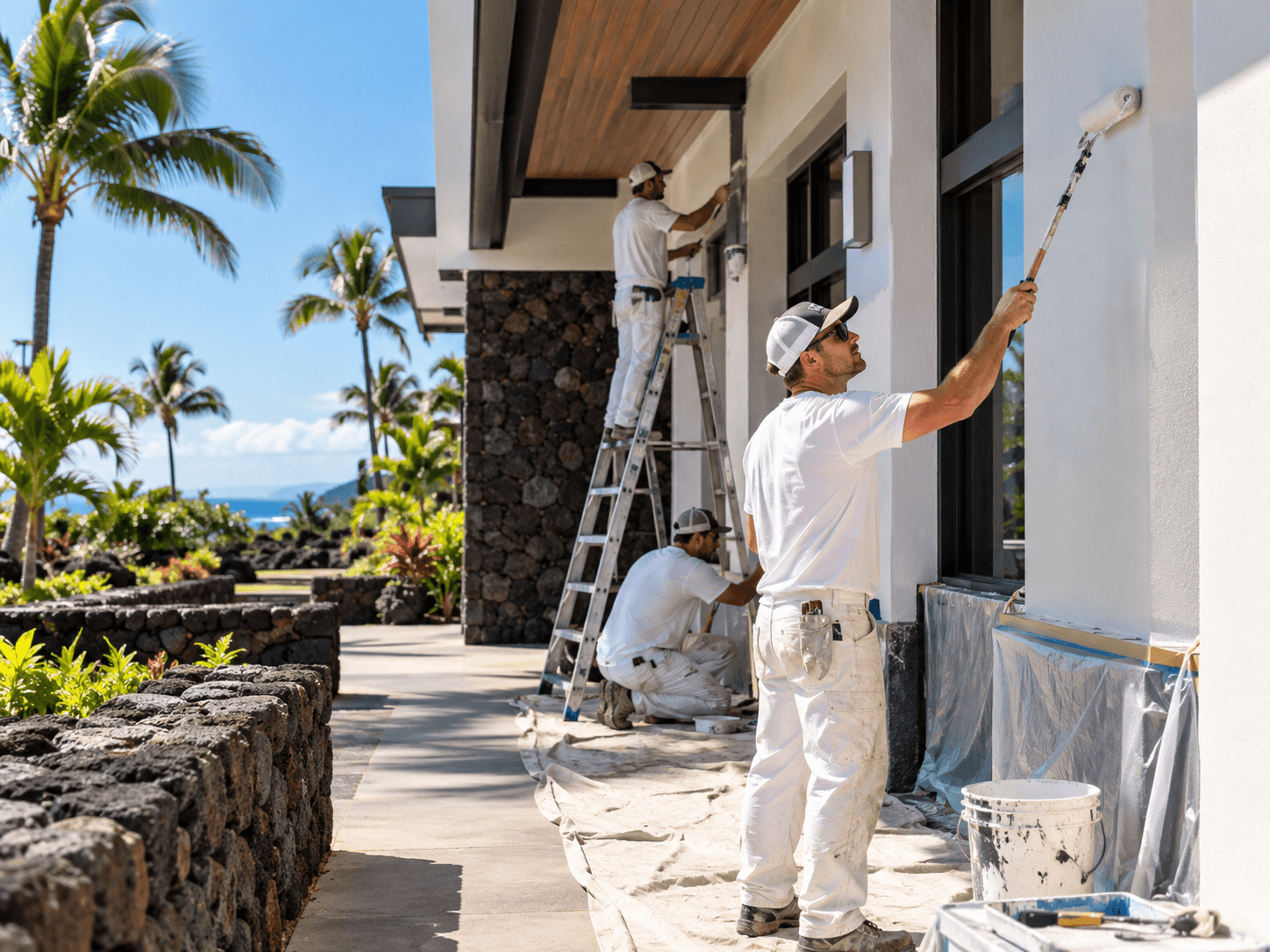
A commercial painting service can include more than applying a finish coat. The useful scope begins with the surfaces, their condition, the property’s daily use, and the result the owner needs to maintain.
A Hawaii Island business may need interior refresh work, exterior maintenance, pressure washing, or a combination. Those services can interact, but they are not interchangeable: cleaning may remove surface soil, while damaged coatings or substrate problems need a separate assessment.
This guide explains how to define a commercial painting service and decide which work belongs in the same project. TTT Industries serves Hawaii Island with painting and property cleaning; a site visit is the practical way to confirm scope.
Table of Contents

Quick Facts and Key Takeaways
| Topic | What to Know |
|---|---|
| Service definition | Named surfaces, preparation, coating, protection, and closeout |
| Possible adjacent work | Pressure washing and solar panel cleaning, scoped separately |
| Business constraint | Access, open hours, pedestrian routes, and dry time |
| Key safeguard | List exclusions and a written change process |
| Best first step | A site walk with photos and a surface-by-surface list |
Separate the service from the outcome
“Painting” describes the coating work; the outcome may be a refreshed reception area, protected exterior trim, or a more consistent customer-facing finish. Describe the outcome first, then list the surfaces and the condition they are in. The contractor can translate that into preparation, products, access, and sequencing.
Do not assume that pressure washing repairs peeling paint, or that a new coating solves moisture intrusion. The service provider should identify what cleaning can address and flag repairs that need a different trade.
Decide what is included
Typical scope questions include washing or hand cleaning, scraping, sanding, patching, caulking, primer, finish coats, masking, moving items, protection, and cleanup. The proposal should say who supplies materials and what happens if preparation uncovers damage. This prevents a vague “paint the building” line from hiding different assumptions.
For businesses, the service may also include dividing the work into phases, keeping a route open, and coordinating with staff. Put these operational requirements beside the coating details so the schedule remains part of the service scope.
Bundle only when the sequence helps
A combined painting and exterior-cleaning plan can reduce duplicated setup when both services are needed. It should still specify the order, wash-water handling, drying time, and which surfaces are safe to clean with the selected method. If the property also has solar panels, panel cleaning is a separate scope with roof-access and module-care considerations.
The best bundle is the one that makes the work easier to coordinate without blurring responsibility. Each task should have its own acceptance check and any exclusions should be visible before approval.
Verified Data Points Worth Knowing
- Sherwin-Williams gives typical paint coverage of roughly 350 to 400 square feet per gallon, with surface texture and the selected product affecting actual yield. Sherwin-Williams Paint Coverage FAQ
- EPA’s RRP rule generally covers paid work disturbing paint in pre-1978 housing and child-occupied facilities; the rule has specific scope thresholds and exceptions. EPA Lead Renovation, Repair, and Painting Program
- Hawaii’s Clean Water Branch lists permits for certain stormwater and non-stormwater discharges; the correct requirements depend on the activity and discharge route. Hawaii Department of Health Clean Water Branch Permits
These references provide general context. They do not establish a Hawaii Island quote, certify a particular contractor, or replace product labels, manufacturer instructions, or rules that apply to the specific property.
What to Check Before You Begin
Use the site condition, written scope, access plan, and closeout details to compare options. Ask the provider to explain any assumption that affects cost, safety, material choice, or schedule.
- Describe the desired result and list every surface in scope.
- Ask what cleaning, repairs, primer, coats, protection, and cleanup are included.
- Keep paint, pressure washing, and solar panel cleaning as named work items.
- Confirm work sequence, dry time, business access, and water management.
- Record exclusions and additional-work approval before work begins.
TTT Industries and Other Ways to Handle the Project
The comparison below is a planning aid, not a ranking. Match the approach to the project size, surface condition, access, and qualifications the work requires.
| Approach | Potential strength | Limit to consider |
|---|---|---|
| Painting only | Clear coating scope for defined surfaces | May leave adjacent cleaning or maintenance for another visit |
| Painting plus washing | Can coordinate exterior preparation | Specify sequence, substrate limits, and runoff control |
| Property-wide maintenance | One plan for several upkeep tasks | Keep separate acceptance checks and qualified providers |
No approach suits every property. Compare the actual work, access, and risk before choosing between a specialist, a broader maintenance provider, or an owner-managed project.
A Practical Hawaii Island Project Plan
- Photograph each area and label the surface material.
- Describe the business use and any access restrictions.
- Request a line-item scope for each service requested.
- Review the order of cleaning, repair, priming, and coating.
- Complete a walkthrough against the written scope.
A written plan makes the work easier to review because the owner and provider can see the same surfaces, responsibilities, and decision points. Adjust the steps to the property and confirm product or safety requirements with the appropriate source.
When TTT Industries Is a Good Fit and When It Is Not
TTT Industries offers painting, pressure washing, and solar panel cleaning on Hawaii Island. The site and service details determine whether one visit or a coordinated sequence makes sense. For specialty coatings, major repairs, or electrical diagnostics, use the appropriately qualified provider. See current commercial services.
Related Reading Within This Topic Cluster
- Commercial Painting Guide for Hawaii Island for related planning and service guidance.
- Commercial Painting Company on Hawaii Island for related planning and service guidance.
- Commercial Painting Contractors in Hawaii for related planning and service guidance.
These topics answer different questions within the same service area. Link the live pages together after publication so readers can move from initial research to a more specific planning decision.
Commercial painting service: plan around the property and business
A commercial painting service starts with the building, surfaces, and operating requirements. Identify the areas to be painted, surface condition, access restrictions, and any visitors or staff who use the space. The project scope should reflect how the property functions during normal operations.
Ask which preparation and coating tasks are included. Confirm cleaning, repairs, primer, paint products, coats, protection, equipment, and cleanup. If a separate trade must address damaged materials or water intrusion, clarify that before painting is scheduled.
Plan work zones with the site contact. Discuss entrances, deliveries, tenant areas, equipment, security rules, and any times when specific spaces cannot be reached. A clear communication path helps staff know what is happening and gives the crew a way to resolve access questions.
Before approving the estimate, review schedule assumptions, exclusions, payment terms, and closeout expectations. Keep changes in writing so the owner and contractor share the same scope. TTT Industries provides commercial painting on Hawaiʻi Island and can discuss the building and business needs with you.
Before a commercial painting service is scheduled, confirm who can approve access and changes on site. A named contact and current work plan help the business and painting crew coordinate questions without confusion.
Ask the contractor to identify any decision the business must make before work starts, such as color approval, access timing, or equipment relocation. Resolving these items early can make project coordination more predictable.
Final Thoughts
The most useful decision starts with the property and the work it needs. Review the actual condition, compare a clear scope, and make sure the plan respects access, safety, materials, and local site conditions.
For a Hawaii Island assessment, contact us and describe the surfaces or service you want reviewed. The company can confirm whether the request fits its current scope.