

Exterior painting services may be sold as a complete repaint, targeted maintenance, trim work, or a combination with washing and repairs. Homeowners get a more useful estimate when they identify the surfaces and the problem they want solved instead of asking for a generic “paint the outside” price.
Hawaii Island conditions can vary by neighborhood and by the home’s orientation. A service that suits a shaded wall may not suit a sun-exposed or salt-facing surface. The product and preparation need to follow the substrate and its exposure.
This guide explains how to define exterior painting services, what a quote should cover, and when another trade may be needed. TTT Industries provides painting and property cleaning on Hawaii Island.
Table of Contents
Quick Facts and Key Takeaways
| Topic | What to Know |
|---|---|
| Service choices | Spot maintenance, trim, one elevation, or whole-house work |
| Before coating | Repair active leaks, rot, loose masonry, or other substrate problems |
| Wash sequence | Select method, control runoff, and allow suitable drying |
| Closeout | Coverage, cleanup, touch-ups, and product record |
| Local factor | Exposure and surface condition vary around Hawaii Island |
Choose a complete service or a targeted repair
A targeted repaint may make sense when only a small area is failing and the existing finish can be matched. A full elevation or whole-house scope may create a more uniform appearance when fading and weathering are widespread. Ask the painter to explain where a spot repair is likely to remain visible.
Some defects belong outside painting: active leaks, rotten framing, loose stucco, or corrosion that affects the substrate. A painter can document those findings, but the owner may need a carpenter, roofer, or other qualified specialist before coatings are applied.
Keep washing and painting in the right order
If washing is included, the scope should explain which surfaces will be cleaned, how delicate areas are protected, and how long the substrate must dry before coating. High pressure is not automatically the right choice; the method should suit the siding, caulk, trim, and nearby openings.
For work near drains or waterways, confirm the wash-water handling plan. Hawaii DOH maintains permits for specified discharges, and local rules can depend on the activity and location. The provider should not assume that all wash water may flow to the nearest drain.
Confirm what “finished” means
A completed service should have a clear closeout standard: even coverage under normal viewing conditions, protected adjacent surfaces, removed masking, collected debris, and agreed touch-ups. The proposal should say whether the owner provides color approval and who documents areas that could not be reached.
Ask for any maintenance guidance the product maker provides. Keeping a record of color, product, sheen, and application date can help with future repairs without implying a guaranteed service life.
Verified Data Points Worth Knowing
- Sherwin Williams describes exterior paint coverage as roughly 250 to 400 square feet per gallon, depending on the product and surface.
- Hawaii’s Clean Water Branch lists permits for certain stormwater and non-stormwater discharges; requirements are activity- and location-specific.
- OSHA’s 2024 construction fatality summary cited 389 fatal falls to a lower level among 1,034 deaths.
These references provide general context. They do not establish a Hawaii Island quote, certify a particular contractor, or replace product labels, manufacturer instructions, or rules that apply to the specific property.
What to Check Before You Begin
Use the site condition, written scope, access plan, and closeout details to compare options. Ask the provider to explain any assumption that affects cost, safety, material choice, or schedule.
- Decide whether the goal is spot maintenance, an elevation, or a full exterior repaint.
- Separate painting from repairs that need a different trade.
- Specify washing method, drying time, and runoff management.
- Define the closeout standard and touch-up process.
- Keep a record of the coating system used.
TTT Industries and Other Ways to Handle the Project
The comparison below is a planning aid, not a ranking. Match the approach to the project size, surface condition, access, and qualifications the work requires.
| Approach | Potential strength | Limit to consider |
|---|---|---|
| Targeted repaint | Lower disruption when failure is localized | Color and sheen may not blend with aged coating |
| Full elevation | Uniform result across one face | More preparation and access may be needed |
| Whole exterior | Coordinated appearance and scope | Requires broader scheduling and household planning |
No approach suits every property. Compare the actual work, access, and risk before choosing between a specialist, a broader maintenance provider, or an owner-managed project.
A Practical Hawaii Island Project Plan
- Photograph problems and note each location.
- Ask for an assessment of the cause before choosing spot or full coverage.
- Approve a service scope with preparation and runoff details.
- Set access, weather, and dry-time expectations.
- Record products and inspect the completed work.
A written plan makes the work easier to review because the owner and provider can see the same surfaces, responsibilities, and decision points. Adjust the steps to the property and confirm product or safety requirements with the appropriate source.
When TTT Industries Is a Good Fit and When It Is Not
TTT Industries may be considered when a Hawaii Island home needs painting or pressure washing as part of property upkeep. A service visit can help determine whether the work is cleaning, coating, or a repair outside the painting scope. Review residential services before requesting a quote.
Related Reading Within This Topic Cluster
- Exterior House Painter Guide for Hawaii Island for related planning and service guidance.
- Exterior Painters for Hawaii Island Homes for related planning and service guidance.
- Exterior House Painters on Hawaii Island for related planning and service guidance.
These topics answer different questions within the same service area. Link the live pages together after publication so readers can move from initial research to a more specific planning decision.
Exterior painting services: define the scope and sequence
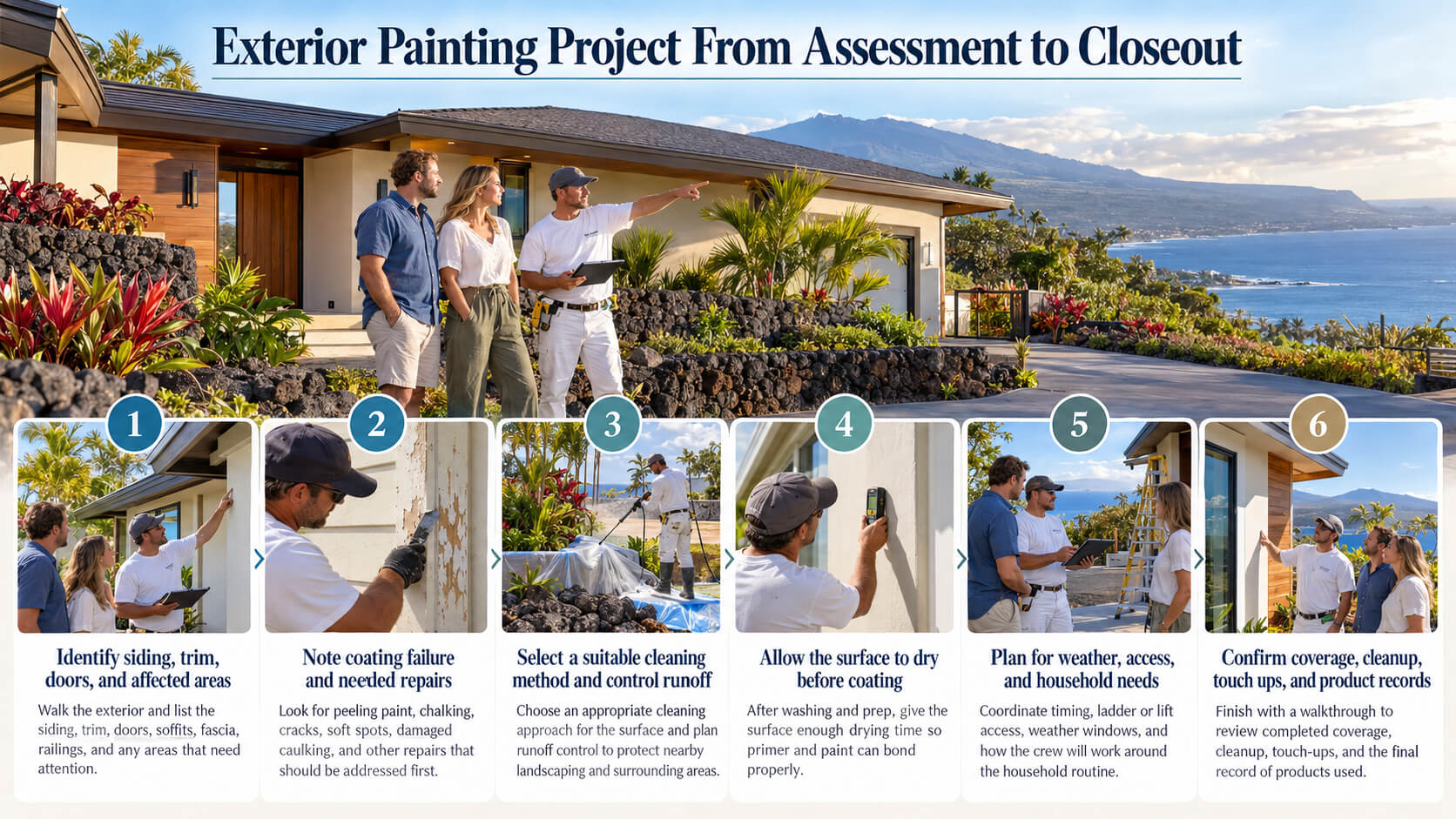
Exterior painting services should begin with a review of the surfaces, existing coating, access, and visible damage. Identify siding, trim, fascia, doors, and any areas that should be excluded. A clear list makes it easier to discuss preparation and compare estimates.
Ask how cleaning, drying, scraping, sanding, repairs, primer, and painting fit together. These tasks have different purposes and timing. If pressure washing is planned, clarify which surfaces it is suitable for and how long they need to dry before the next preparation or coating step.
Weather planning is part of an exterior project. Discuss how rain, wind, direct sun, and damp surfaces may affect scheduling and application. Ask who will decide whether conditions are suitable and how the schedule will be updated if work needs to pause.
Before approving the proposal, confirm products, coats, color approval, protection of nearby areas, cleanup, and final inspection. TTT Industries provides exterior painting on Hawaiʻi Island. Contact the company with the surfaces and property details you want reviewed.
Before exterior painting services start, confirm that the proposal matches the latest property notes and weather plan. Save the approved product and color details so everyone can refer to the same choices during application and the final review.
Do not schedule coating work until the surface condition and drying needs have been discussed. If rain or moisture changes the plan, ask for an updated sequence and timing before the next step proceeds.
When assessing “exterior painting services,” document siding, trim, eaves, stories, access, coating condition, and visible repairs before discussing a schedule. An exterior scope for “exterior painting services” should explain washing, scraping, caulking, repairs, primer, finish coats, masking, and cleanup where relevant.
Final Thoughts
The most useful decision starts with the property and the work it needs. Review the actual condition, compare a clear scope, and make sure the plan respects access, safety, materials, and local site conditions.
For a Hawaii Island assessment, contact TTT Industries and describe the surfaces or service you want reviewed. The company can confirm whether the request fits its current scope.